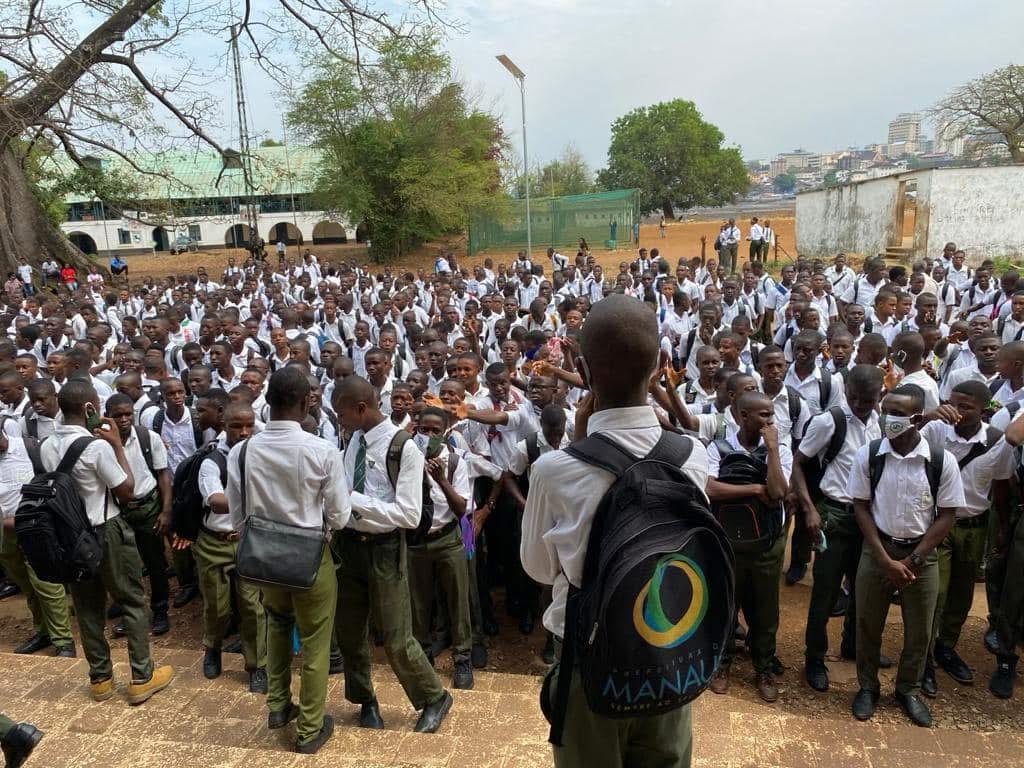
At that time, the Government of Sierra Leone had been making efforts to acquire a suitable site for the newly created Government Secondary School. Its search led to a disused Coaling Station that came with its very own derelict jetty at the back of the main building, formerly owned by the Sierra Leone Coaling Company, and later acquired by the Wesleyan Methodist Mission. Government of Sierra Leone purchased this complex for the purpose of transforming the campus to be the new home of the Government Secondary School.
It did general repairs and the refurbishment of the old building, and on completion, in October 1924, the Government Secondary School was transferred from the premises of Government Model School at the junction of Circular Road and Berry Street to the new school site at Hennessy Square, Kingtom, as it was previously known. He recalls that Mr. H. Evans was still the principal, and the well-qualified teachers who relocated with the school included Mr. E.W. Turner, M.A., Rev. Ejesa Osora, M.A., Oxon; and Mr. R.B. Mark, B.A., BCL, LLB. The first set of eighteen students of form IV, the senior class of the Government Secondary School, transferred to Kingtom, later joined by the other lower classes. The first Head Prefect was Mohammed Sanusi Mustapha.On April 5, 1925, the Prince of Wales arrived in Freetown on a royal visit aboard the HMS. Hood and his program included the official opening of the school. Freetown was, at that time, being administered from Great Britain by the appointed Governor, residing in Freetown.
On April 6, 1925, the Prince, as guest of honor, arrived at the Kingtom grounds of the relocated Government Secondary School for the grand opening ceremony. The pupils lined up in front of the main building in two flanks, facing each other, like a guard of honor formation. On arrival, the Principal and Vice Principal received H.R.H. The Prince of Wales escorted him to the entrance of the Main Building. His Royal Highness was greeted at the entrance of the building by the first Head Prefect, Mohammed Sanusi Mustapha (Admission Number 2), who presented him with a Gold Key with which he officially opened the door to the Main Building.
The Prince of Wales, escorted by the Principal and Vice Principal, then did a tour of the Main building and the two newly constructed Science blocks: Chemistry and Physics. He watched some demonstration experiments in the Chemistry Laboratory supervised by the then Laboratory Assistant, Mr. Arawala Miller. After the tour of the school facilities, he returned to the front of the main building, where all the pupils were still lined up. Sanusi Mustapha delivered the welcome address, and His Royal Highness responded and named the school, THE PRINCE OF WALES SCHOOL. He also declared April 6 the FOUNDATION DAY of the School, and pronounced that the school should share his birthday 23rd of June.
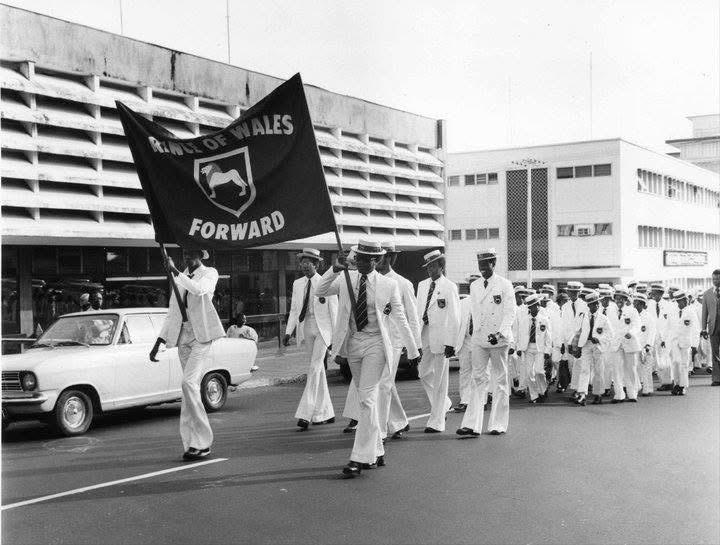
The Prince of Wales then shook hands with all 117 pupils in the lineup, the number in the Admissions Register at that time. The tradition of dressing up in full academicals for important school occasions originated from this launch and the practice has upheld since.
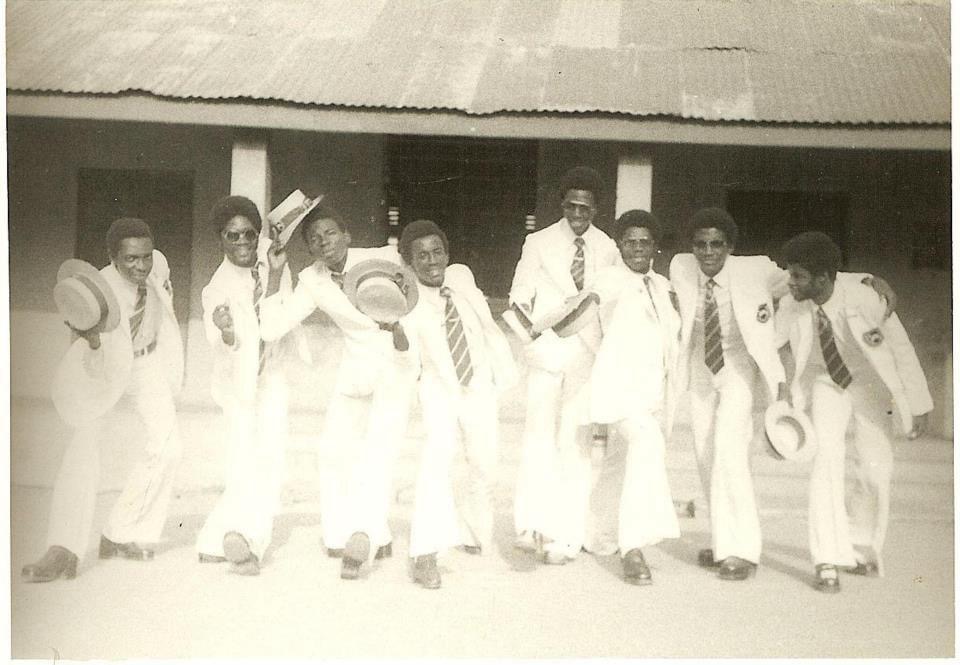
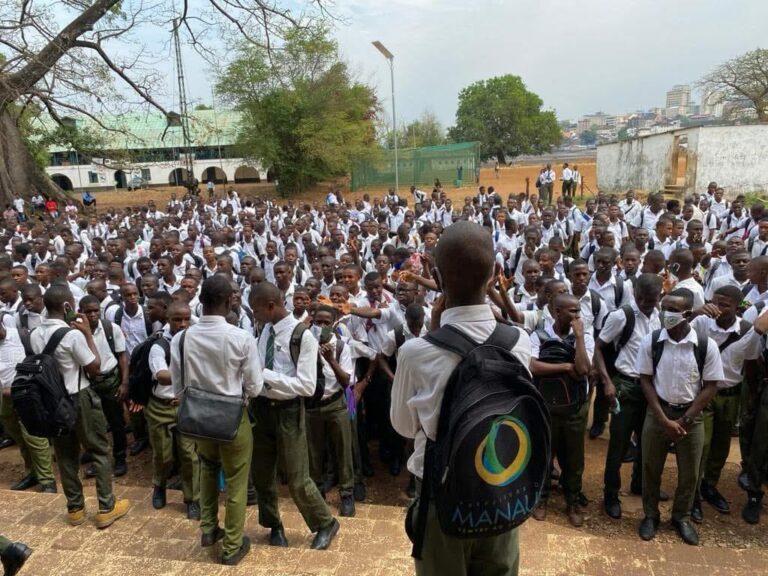
The everyday uniform evolved to become khaki shorts and a white shirt, and the ceremonial uniform was the customary white suit, boater (optional), and green school tie, leading to the coined-up phrase ‘san ten ghost’ to describe Princewaleans in their ceremonial uniform. Later, when female students became part of the student population, a white blouse and green skirt, in addition to the school tie and chest badge, were their uniforms.
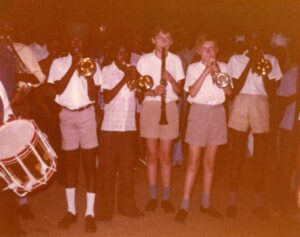
On the following day, the 7th of April 1925 (which was a Tuesday), the whole school, Principal, Teachers, and Pupils all congregated at the school’s former premises, the Government Model School, from where they marched along Circular Road to the Parade Grounds at Tower Hill. At the Parade Grounds, they were greeted by other schools in the city who had assembled to welcome THE PRINCE OF WALES SCHOOL as the newest secondary school in Freetown. THE PRINCE OF WALES marched into the Parade Grounds amid a ‘thunderous ovation of Jubilation’ from the crowd.
Even in 1925, the Prince of Wales School exemplified multi-faith coexistence. The first Thanksgiving held at the Manual Training Building on the right-hand side of the school’s Main Building comprised the First Christian and Muslim Services conducted by school pupils. The Christian Service by Harry Sawyerr (who later became Rev. Professor Harry Sawyerr) and the Muslim Service were conducted by Sanusi Mustapha (a pupil who later became the Hon. Alhaji Dr. Mohammed Sanusi Mustapha and Vice President of the Republic of Sierra Leone) in collaboration with Madiana Sanusi. There was no band and no marching after the service. The pupils only enjoyed their own ‘company and a brief reunion’ amongst themselves.